
Why is AI Implementation in Healthcare No Longer Optional?
Imagine entering a clinic for a routine check-up. As usual, you wait for the receptionist to give you a form to fill out. However, surprisingly, there is no form to fill out this time. Instead, a sleek, digital, AI-powered tablet begins interacting with you. It asks some simple questions about your sleep, stress levels, and the pestering lower back pain you mentioned a few months ago.
Now, the doctor walks in. You see an AI scribe listening to your conversation, analyzing every word, capturing the nuances of your symptoms, and updating your digital records instantly. The doctor notices a subtle improvement in your resting heart rate, based on your wearable fitness data from the previous month. Thus, they prescribe a slight tweak to your vitamin regimen. Every decision is data-driven.
No. This is not a futuristic vision but AI in healthcare that works purely on hard data, advancing technology, and urgent needs.
From enhancing diagnostic accuracy to augmenting healthcare operational efficiency, AI is redefining healthcare, improving patient outcomes, and making healthcare more reliable than ever before. AI implementation in healthcare is no longer optional but a necessity. Now, if you are a healthcare provider looking for AI implementation services or guidance from a healthcare AI implementation consultant, this blog explains why it is not an option anymore.
The Increasing Use of AI in Healthcare
AI already has a massive market in healthcare. In 2025, it was valued at USD 39-40 billion. Further, in 2026, it is projected to reach USD 56-57 billion! By the mid-next decade, the market value is expected to surpass the trillion-dollar mark. While market estimates vary by source, the upward trajectory is undeniable. Nevertheless, these figures reveal a fundamental shift. AI is no longer a fringe technology.
However, it isn’t merely about the market size. AI also helps the healthcare sector save a significant amount of time. For instance, a major healthcare provider saved thousands of employee hours per month by using AI to sift through millions of transactions. These figures indicate or reveal a clear truth. AI is no longer a fringe technology. It is a generational shift and a core aspect of modern clinical operations.
While numbers speak a lot, what also matters is the story that drives them. Evidently, it is the benefits that healthcare AI implementation delivers. Here are ten such advantages.
10 Benefits of Healthcare AI Implementation
From improving diagnostic accuracy to early prediction of critical events, AI is revolutionizing healthcare in different ways, strengthening the overall ai implementation healthcare framework.
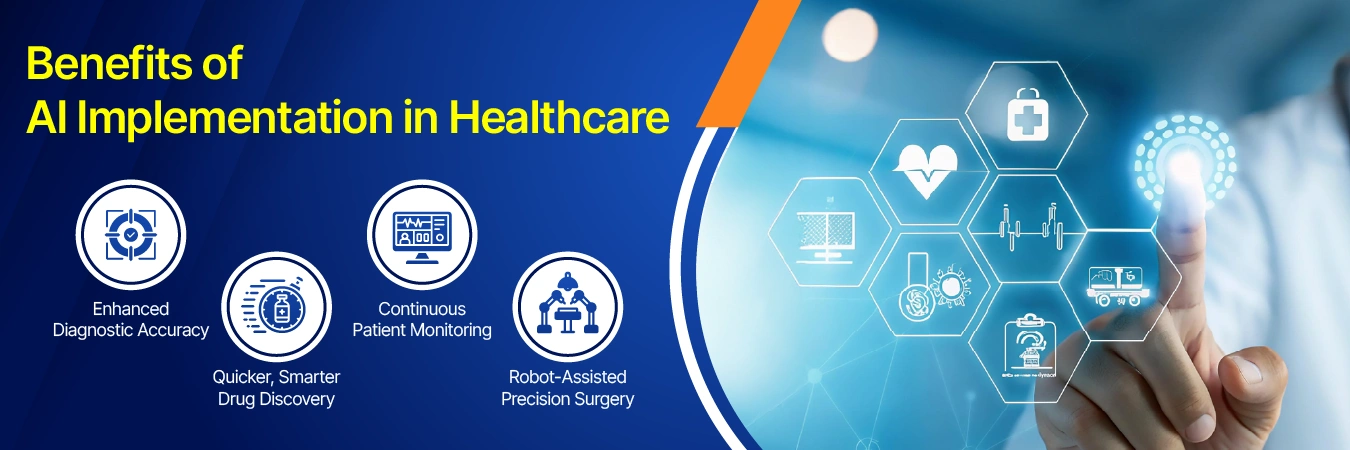
1. Enhanced Diagnostic Accuracy
Accurate diagnosis is the foundation of the right treatment course.
The healthcare sector has been using advanced diagnostic devices for years. Yet, depending on humans for factors such as pattern detection has been common. One cannot discount the role of human intelligence in diagnosis. Yet, human clinicians are susceptible to fatigue and cognitive bias, which can lead to diagnostic oversights.
This is where AI comes into play. It can detect patterns in imaging and patient data that humans may miss. A diagnostic AI system that can read radiology scans can improve with every image it processes. Such a system is faster, more reliable, and less vulnerable to oversight, which is likely when you rely fully on humans within an ai implementation healthcare environment.
2. Quicker, Smarter Drug Discovery
Drug R&D once took decades and billions of dollars. While painstaking research matters, the world today demands faster outcomes. AI can help here. The technology can accelerate the process by scanning molecular datasets and simulating interactions. It is already helping identify promising compounds faster, shortening development timelines and reducing costs. This is critical to the world’s endeavors in treating serious diseases.
3. Continuous Patient Monitoring
Continuous health monitoring is one of the keys to enhancing patient outcomes. Earlier, doctors could assess a patient’s health once a week or a month when they visited the clinic for a check-up. Traditional episodic care often misses subtle, early warning signs of deteriorating health. But AI-powered wearable and remote sensing systems track vitals 24/7. They alert clinicians in real time to trends such as oxygen desaturation or heart rate spikes. It enables early intervention and timely actions.
4. Robot-Assisted Precision Surgery
One cannot deny human expertise and skill in performing surgeries. But surgeries, whether major or minor, warrant a great amount of precision as well – in some cases, as minute as sub-millimeters! These systems maximize surgical precision and minimize patient trauma.
AI-powered robotic systems help achieve such levels of precision. They work as assistants, enabling surgeons to enhance surgical precision and amplify the procedure’s impact. Besides, these systems provide real-time guidance, curbing the size of incisions and also the patient’s recovery time.
5. Personalized Medicine
AI is also helping revolutionize the domain of personalized medicine, specifically genomics. AI platforms analyze massive libraries of clinical and genomic data to suggest the oncology treatment that will work for a particular individual’s genetic makeup.
For instance, conventionally, if ten patients have the same type of lung cancer, they would receive the same chemotherapy. But the human body is genetically unique. Therefore, the treatment may work for a few patients, but the rest may still suffer. AI changes this by shifting the focus from the disease to the patient’s genetic profile.
6. Streamlined Administrative Workflows
The use of AI in healthcare isn’t anchored to its core clinical aspects. It extends to the administrative dimension of the domain as well.
Manual workflows drain a lot of a doctor’s time, as they spend more time managing administrative tasks than treating patients. AI reduces administrative burdens by automating scheduling, documentation, and claims processing. The technology thus limits human intervention to solving advanced disputes and addressing complex challenges.
AI also enhances processing accuracy, minimizing human errors. As a result, clinicians and hospital staff spend more time with people and improving patient experiences.
7. Better Medical Imaging
Interpreting X-rays, MRI, and CT scan reports has traditionally been the forte of human beings. However, manual interpretation is usually slow. AI accelerates it, helping radiologists spot anomalies faster and more accurately. Of course, the technology does not replace humans in the interpretation process. Instead, it amplifies human capabilities, ensuring faster and more accurate interpretation of images.
8. Minimized Human Error
Human errors could prove to be precarious in healthcare. But AI helps improve the situation, reducing human errors significantly. Well-trained, reliable AI systems can alert providers to drug interactions, unusual results, or risk of mistakes. Therefore, they serve as safety nets for the healthcare domain, preventing errors that could harm patients.
9. Fraud Detection and Billing Accuracy
Healthcare fraud is a critical concern that costs billions of dollars globally. Besides, the frauds and their nature keep evolving every year, making it challenging for the healthcare sector to deal with them. AI implementation in healthcare has the potential to curb them. AI systems can scan millions of insurance claims to identify double-billing or unbundled services that the human eye may miss. Beyond preventing financial loss, AI ensures billing transparency and protects the integrity of patient records.
10. Streamline Triage and Scheduling
The referral loop and scheduling bottleneck are major challenges in modern healthcare. AI virtual receptionists help here by automating appointments, saving time, and reducing costs appreciably. What’s even more crucial is that they can triage patient symptoms through chat to ensure those in need are attended to by the doctor first.
Benefits drive the adoption of AI in healthcare. However, the adoption is not devoid of challenges or obstacles. To become a competent healthcare provider, you must address these hurdles as well. But what are these roadblocks? The next section discusses them.
Challenges of AI Implementation in Healthcare
AI implementation has unique challenges that every organization adopting it must deal with. Healthcare AI implementation consultants help players navigate the challenges. However, knowing them before embarking on the journey to AI can help you prepare for them better and make the most of the technology.
1. Data Privacy and Security Risks
Data is at the core of AI. But healthcare data refers to sensitive information. Therefore, AI systems should comply with regulations such as GDPR, HIPAA, and local data governance laws to safeguard patient privacy and prevent breaches. Cybersecurity is a perpetual concern. A constant battle no organization in the world can afford to lose. Even a single breach can erode trust and have unimaginable consequences. Organizations need robust data security protocols and guards to ensure data safety.
2. Low-Quality, Fragmented Data
AI, its responses, and everything it does are just as good as the data it is trained on. However, in healthcare, data is often scattered across different systems and in inconsistent formats. This can lead to poor data quality, missing entries, duplications, and inconsistent coding. These factors can restrict the ability of AI to learn and deliver accurate responses. Therefore, healthcare organizations must begin by standardizing Electronic Health Records (EHR) to ensure reliability in AI.
3. Algorithm Bias
In healthcare, datasets must represent each population group equally. If not, AI can yield biased outputs, resulting in unequal care outcomes. So, healthcare providers must ensure the data they train their AI models on is rich. Professional AI implementation services play a crucial role, ensuring data quality and models that avoid algorithmic bias.
4. Legacy System Integration
Many healthcare organizations worldwide still work on obsolete, outdated technology. Integrating AI into such legacy infrastructures demands costly upgrades, customized systems, process overhauls, and workflow redesigns. Consulting with experts helps. But organizations must be prepared for such generational shifts to bring a change.
5. Regulatory Uncertainties
The regulatory framework around AI medical tools is still evolving. Therefore, there is a lot of ambiguity around the contribution of AI to clinical decisions. This often slows adoption and complicates legal frameworks. There is an urgent need to clear regulatory pathways to guide secure and accountable use of AI.
6. Workforce Resistance and Talent Gaps
AI is a disruptive technology. Hence, nurses and administrative staff fear it will replace them. They avoid using AI and stick to manual methods to stay relevant. This affects outcomes and puts an organization’s investments down the drain.
In cases where they adopt AI, the lack of training can still lead to struggles that eventually prove to be discouraging. Upskilling is essential when an organization adopts something as transformative as AI.
Connect with FidelSoft for AI Implementation Services
AI does not replace humans but empowers them. Based on the data it is trained on, it can expedite workflows, improve service, and enhance healthcare outcomes.
Nevertheless, adopting AI is complex. Successful adoption requires a strategic roadmap and specialized technical guidance. This is where FidelSoft steps in.
We are experienced healthcare AI implementation consultants with a proven track record of helping healthcare organizations design, develop, and adopt AI systems.
Our comprehensive assistance covers everything from initial conceptualization to deployment and regular upgrades that ensure relevance amid the evolving AI landscape.
So, would you like to explore more about our AI implementation services? Let us connect at sales@fidelsoft.com and discuss your vision.
Ref. No – FB04261006